1. "In a differential diagnosis, include the 'mosts.' The most common, the most dangerous, and the most interesting. Though in the case of acute chest pain, skip the most interesting. Because if someone has ST elevation on their EKG and you're talking to the resident about parasitic pericarditis, they're going to hit you with the clipboard. And so they should."
2. "Speaking as an internist, every last one of you in this room has a pulmonary embolism until proven otherwise. That is something you never ever want to miss."
3. Apparently there is an outlet for my hypochondria and tendency to catastrophize: unleash it on my patients! "Put in the differential the absolute worst things it could be...the really bad shit. Because you'd feel really bad if the patient died and you had to say, 'Oh, a pneumothorax...I never thought of that!'"
4. 'If a little is good, a lot is better' does not apply to high-fiber cereal bars, no matter how tasty they may be. Remember that SNL spoof about 'Colon Blow' cereal? Back when SNL was funny? Yeah.
5. Physicians, especially ER docs, really seem to relish catching malingerers. Their eyes always light up when they talk about it, and they start grinning like feral chipmunks. For instance, someone complaining of chest pain angling for MI-type attention who says it hurts when you press *right there* is probably faking it. That's musculoskeletal. "I always tell them, oh, good, I think you're out of the woods. Peace."
6. Having whacked out hormone levels (though not, as of yet, any confirmed $%&# diagnosis) has made me a little...hairier than usual. Supposedly acne is also part of the sideshow. "At least I don't have that," I consoled myself. Wrong. Long workouts + androgens + ubiquitous bacteria = not just acne but, cruelly, ass-ne. *Is there no end to the ignominy?!?!*
7. My first hospital session (with an actual patient) is next week. I'm a little (ok, a lot) nervous. Hopefully I will not blind the patient with the ophthalmoscope or forget part of the physical or lose my train of thought during the history and just sit there staring blankly. No. All will be well.
Showing posts with label beauty. Show all posts
Showing posts with label beauty. Show all posts
Thursday, October 8, 2009

Thursday, January 22, 2009
Ok, I'm gonna do ID instead.
What's ID, you ask? It's more than what I get asked for every time I want to see a rated-R movie or buy a pack of cigs (My for-real, I'm in an American Lung Association sponsored smoking cessation class quit date is Feb 3rd--wish me luck. In the interim, the woman at the corner store-- with what are apparently the early signs of dementia--asks me every single time, "What are you, in middle school?" No, ma'am. Just flat-chested and baby-faced. Moisturize, and you too could be mistaken for half your age!). It's Infectious Disease, y'all, and it's super cool.
Did you know there are more microbes in and on your body than there are cells that belong to you? So even if you're an atheist, or agnostic, or on a desert island...you're REALLY never alone. I know it's weird, but it's sort of a comforting thought. You, by yourself, are a community--an ecosphere all your own!
There are lots of microbes that live happily with you and don't cause any disease...it's called commensalism, or mutualism. Actually some bacteria even feed you--making Vitamin K in your intestines, for example. Others live on your skin and keep bad guys like MRSA (the nasty 'superbug' that's been in the news lately) from taking over...like your own little bacterial bouncer patrol.
And even bad bugs--enterococci that cause gastritis, para ejemplo--have some mechanisms of action that are truly amazing (sort of like how you hate the Bond villain in every movie but are frankly amazed at the intricacy and detail of his/her evil schemes): E. coli can actually get INTO your bladder cells and chill out there, evading detection. You get treated for a UTI, all the 'outside' bacteria are wiped out, but then there are these little 'seeds' of e. coli lying dormant-ish, waiting, and then BAM! Even though you haven't been reinoculated (ie, you haven't gotten more bacteria into your bladder by having sex and not peeing afterwards, or wiping back-to-front, or wearing tight pants, or whatever else is on the 'not-to-do' list these days) you're reinfected. Whoa. Take that, Mr. Bond.
Also, staphylococcus aureus is named that because 'aureus' is from the (Latin?) root for gold...y'know, Au? Remember the periodic table, kids?...and when you plate them out, the colonies are a brilliant gold color that's frankly stunning. I know I'm going to earn some weird looks for this, but especially when they're plated on blood agar, the contrasting colors are spectacular. I'd put a picture of that up in my living room, with the caveat that no one be allowed to ask what it is.
PS--No, I'm still totally married to psych, but ID is definitely, undeniably enthralling.
Thursday, September 11, 2008
The heart of the matter
So we finally got to look at the heart. You'd think it'd be a fragile thing, especially after eighty-odd years of pumping, but at least in our cadaver it wasn't. I almost said 'specimen,' something some of our professors do from time to time...I'd like to avoid thinking of human bodies as specimens; for that matter, I like to think of even plant and animal exemplars as more than 'specimens'...to quote Mary Oliver,
"Is the soul solid, like iron?
Or is it tender and breakable, like
the wings of a moth in the beak of an owl?
Who has it, and who doesn't?
I keep looking around me.
The face of a moose is sad as the face of Jesus.
A swan opens her white wings slowly...
One question leads to another.
Does it have a shape? Like an iceberg?
Like the eye of a hummingbird?
Does it have one lung, like the snake and the scallop?
Why should I have it, and not the anteater
who loves her children?
Why should I have it, and not the camel?
Come to think of it, what about the maple trees?
What about the blue iris?
What about all the little stones, sitting alone in the moonlight?
What about the roses, and lemons, and their shining leaves?
What about the grass?
--Mary Oliver
His heart was thickened, as you'd expect perhaps in someone with heart disease; his left ventricle had been pumping against high blood pressure so long it was enlarged. When we cut the ventricles open, you could scarcely imagine they ever HELD any blood, the muscle was so hypertrophied. It was as if the thing itself had become so great, its function had all but been forgotten...how often does that happen?, I thought to myself. A cathedral becomes so glorious, overwrought with spandrels and flying buttresses and teeming masses of gilded figures, that the still, small voice it was meant to glorify is lost in the noise (of course, there are places--like St. Patrick's Cathedral in New York, or the Cathedral of Peter and Paul in Philadelphia--that are gilded and Romanesque but which do feel prayed in and USED rather than just admired...where the architecture feels like a solidified prayer rather than a distraction). A habit begins, to comfort and console, or perhaps to celebrate--champagne here, a cigarette to accompany a drink, five pounds lost to overcome a college freshman's feelings of ugly-duckling unbelonging. But it blossoms, and grows, and becomes more than it was ever meant to be, an ugly compulsion with a life of its own, the consoling or celebration or comfort lost in the cacophony of drive: alcoholism, addiction, anorexia.
So I have seen the inside of someone's heart now, the fantastic architecture, the membrane-thin walls of the atria and the thickened, hardy ventricles. I've seen the muscles that hold the valves in place, have run my fingers over the valves that even now are billowing diaphanously together in my chest maybe sixty times a minute (I'm always teetering on the edge of bradycardia--it's all the running). The valves are more like parachutes than valves as we think of them--phenomenally unmechanical, not at all stiff or thick (when they are stiff or thick, in fact, it causes problems and as such is labeled either insufficiency--if the edges of the 'leaflets' don't come together--or stenosis, if the valves are hardened and calcified). We're literally a few layers of cells away from dying at all times--it's amazing the ballet of our bodies doesn't get botched more often, that anyone manages to survive for any time at all.
Monday, September 1, 2008
What the hell is hemoglobin, you ask?
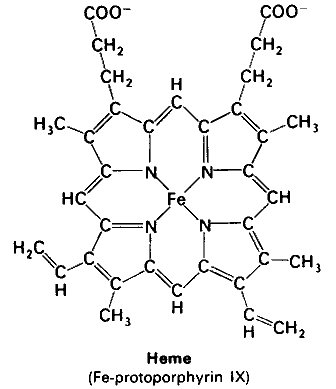
This is heme. It's part of hemoglobin (well, actually just attached to hemoglobin, which from now on will be abbreviated Hgb, by the way), the protein that carries oxygen and carbon dioxide in your blood and ushers it where it needs to go. Gorgeous, no? The whole Hgb protein is even more impressive; this is just the metalloprotein accessory group that makes the whole shebang possible. See, Fe (iron) likes to bind oxygen, but oxygen likes to (duh) oxidize things, including iron. So what's an aerobically respiring organism to do? Bind the whole thing up in a protein environment (ie, the interior of an Hgb protein--not a molecule, by the way, because it's made up of four individual parts. It's called a tetramer, from tetra for four--again the geniuses with the dead languages thinking no one will know what they're up to) where oxygen is prevented from oxidizing anything. Seriously, google hemoglobin. I urge you. Even if only to look at the pretty pictures. Just think--right now YOU are producing that. You, sitting there in front of the computer with your bag of potato chips (and, somewhat ironically, a diet Coke) are spinning out these amazingly complicated, intricately turned proteins. Damn. More on the coolness of Hgb to come.
Subscribe to:
Posts (Atom)